Introduction: America at an Inflection Point
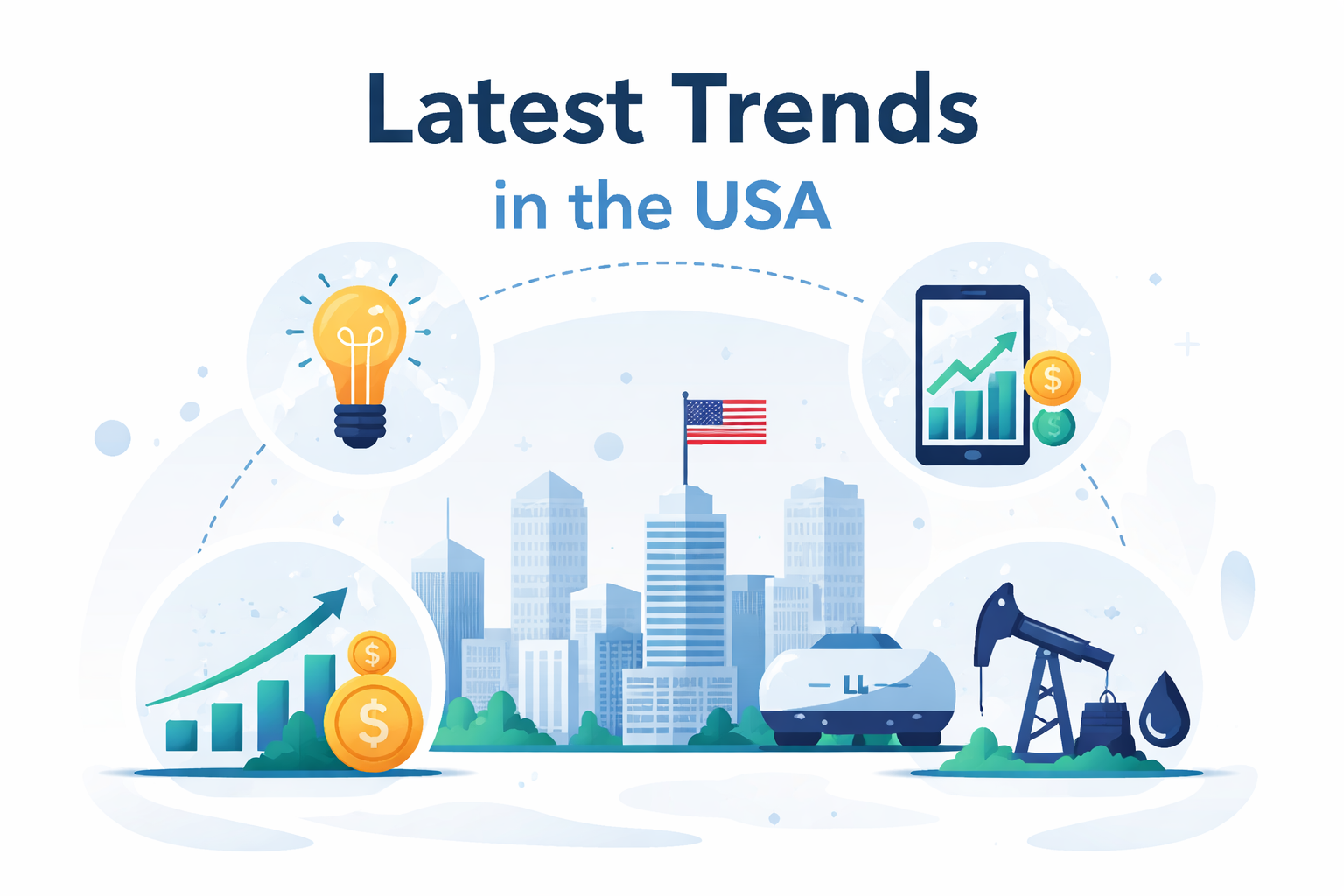
The United States is entering one of the most transformative periods in recent history. From artificial intelligence breakthroughs to geopolitical tensions reshaping global trade, from volatility in the stock market today to renewed interest in gold and silver prices today, the country is experiencing structural shifts across technology, energy, finance, and global power dynamics.
Investors are closely watching the S&P 500, the 10 year Treasury yield, and safe-haven assets like gold and SLV. Tech leaders are redefining the AI race. Energy giants like Chevron and Occidental are navigating a new oil landscape. Meanwhile, ETFs such as VOO, VTI, QQQ stock, and SCHD are becoming core tools for retail and institutional investors alike.
Let’s break down the biggest trends shaping the USA in 2026.
1. The AI Supercycle Is Redefining the American Economy
Artificial intelligence is no longer experimental — it is foundational.
Companies like Alphabet Inc. (GOOG stock), Apple Inc. (AAPL stock), Palantir Technologies (PLTR stock), Broadcom Inc. (AVGO stock), MongoDB (MDB stock), and Taiwan Semiconductor Manufacturing Company (TSM stock) are leading the AI infrastructure and software revolution.
Key AI Trends in 2026:
- Enterprise AI adoption accelerating across healthcare, insurance, and finance
- AI copilots embedded in productivity tools
- Defense AI investments increasing
- Chip demand reshaping semiconductor supply chains
The surge in PLTR stock reflects how governments and enterprises are investing in AI-driven analytics. Meanwhile, TSM stock is a proxy for the global semiconductor demand fueling generative AI.
The broader market impact? AI is contributing significantly to S&P 500 earnings growth and pushing SPX valuations higher.
2. The Stock Market Today: Volatility as the New Normal
If there’s one defining theme in the stock market today, it’s volatility.
The S&P 500 (often referenced as SPX or S&P500) has been navigating:
- Geopolitical tensions
- Inflationary pressures
- Fluctuations in the 10 year Treasury yield
- Energy price shocks
- Tech sector rotations
Major indices trading on the New York Stock Exchange (NYSE) are experiencing increased intraday swings.
Investors are increasingly turning to ETFs like:
- VOO stock (tracking the S&P 500)
- VTI (total market exposure)
- QQQ stock (Nasdaq heavy tech exposure)
- SCHD (dividend-focused ETF)
These ETFs provide diversified exposure while reducing single-stock risk.
3. Energy Resurgence: Oil, LNG, and Strategic Security
Energy has re-emerged as a powerful theme in the U.S. economy.
Companies like:
- Chevron Corporation (CVX stock)
- Occidental Petroleum (OXY stock)
- Cheniere Energy (LNG stock)
are benefiting from global supply constraints and geopolitical instability.
As tensions rise globally, oil prices remain sensitive to political developments. This strengthens energy equities and pushes inflation expectations higher — impacting the 10 year Treasury yield.
Energy ETFs and oil stocks are becoming a hedge against inflation uncertainty.
4. Defense & Aerospace: A New Investment Theme
Defense spending is rising.
Stocks such as:
- Lockheed Martin (Lockheed Martin stock)
- AeroVironment (AVAV stock)
- Boeing (Boeing stock)
- AST SpaceMobile (ASTS stock)
are gaining attention from institutional investors.
Geopolitical conflicts and satellite defense programs are driving renewed focus on aerospace innovation.
Defense stocks often perform well during uncertainty, offering portfolio stability when growth stocks fluctuate.
5. The Safe Haven Trade: Gold and Silver Surge
With inflation concerns and global risk, gold and silver prices today are trending upward.
Investors are:
- Buying physical gold
- Allocating to gold ETFs
- Trading SLV (silver ETF)
Gold remains a hedge against currency debasement and macro instability.
When the 10 year Treasury yield falls, gold often rallies. When geopolitical risks rise, silver prices follow.
6. Insurance & Healthcare: Defensive Strongholds
Healthcare and insurance remain pillars of stability.
Companies like UnitedHealth Group (UNH stock) show resilience during market downturns.
Insurance firms are adapting to:
- Climate risk
- AI-driven underwriting
- Automated claims processing
Healthcare AI integration is reducing costs while improving patient outcomes — another example of AI’s cross-sector dominance.
7. Big Tech Dominance Continues
Despite regulatory scrutiny, Big Tech continues to dominate market capitalization.
AAPL stock remains one of the largest contributors to S&P 500 performance. GOOG stock continues investing heavily in AI and cloud.
Costco stock (Costco Wholesale Corporation) reflects consumer resilience in a high-rate environment.
Tech concentration in QQQ stock has made it a key performance driver for growth-focused investors.
8. Interest Rates and the 10 Year Treasury Yield
The 10 year Treasury yield remains the most important macro indicator in 2026.
It impacts:
- Mortgage rates
- Equity valuations
- Dollar strength
- Corporate borrowing costs
Higher yields compress growth stock valuations. Lower yields boost risk assets.
Markets continuously reprice based on inflation data and Federal Reserve expectations.
9. Retail Investor Renaissance
Platforms like Robinhood and digital brokerage accounts have democratized investing.
Retail participation in:
- SPX derivatives
- Meme stocks
- Growth names like SOFI stock (SoFi Technologies)
- Semiconductor plays like TSM stock
has created liquidity waves.
Younger investors increasingly use VTI and SCHD for long-term wealth accumulation.
10. Commodities & Alternative Assets
Beyond oil and gold, commodities are becoming mainstream portfolio components.
Silver prices today are attracting momentum traders.
Energy infrastructure and rare earth metals are gaining strategic importance due to EV and AI demand.
11. Leadership Voices & Market Psychology
Prominent financial voices such as Lloyd Blankfein continue shaping public market narratives.
Market psychology in 2026 is defined by:
- Fear of inflation
- AI optimism
- Geopolitical risk
- ETF-driven flows
Sentiment cycles are shorter, and algorithmic trading dominates volume.
12. Utilities & Infrastructure Stability
Companies like DTE Energy provide defensive exposure.
Utilities benefit from stable cash flows during uncertain macro cycles.
13. Global Expansion of U.S. Corporate Influence
U.S. corporations are expanding into space, AI, renewable energy, and biotech.
ASTS stock reflects space-based communication ambitions.
Defense companies are collaborating internationally.
Energy exporters like LNG companies are strengthening U.S. geopolitical leverage.
14. ETFs as the Core Investment Vehicle
Passive investing dominates capital flows.
VOO stock mirrors S&P 500 growth.
VTI captures the entire U.S. market.
QQQ stock focuses on tech acceleration.
SCHD prioritizes dividend yield.
These ETFs simplify exposure to market themes.
15. Consumer & Corporate Spending Trends
Despite higher interest rates, consumer spending remains surprisingly resilient.
Costco stock performance reflects bulk-buying behavior in inflationary periods.
Corporate AI investments continue growing despite macro uncertainty.
16. Geopolitical Realignment & Economic Strategy
Global power shifts are impacting:
- Energy prices
- Defense spending
- Semiconductor supply chains
- Trade policy
This reinforces demand for U.S. infrastructure, domestic manufacturing, and strategic reserves.
Conclusion: America’s Multi-Layered Transformation
The latest trends in the USA reveal a country balancing innovation and instability.
AI is reshaping productivity.
Energy markets are redefining geopolitics.
The stock market today reflects both optimism and caution.
The S&P 500 remains the benchmark of economic health.
The 10 year Treasury yield guides valuation.
Gold and silver prices today signal risk perception.
Defense and aerospace are gaining prominence.
ETFs like VOO, VTI, QQQ stock, and SCHD anchor long-term portfolios.
Whether you’re watching AAPL stock, PLTR stock, CVX stock, Boeing stock, or tracking the SPX and NYSE activity — 2026 is defined by rapid transformation.
The United States is not merely evolving.
It is restructuring the architecture of the global economy.
FAQ
What are the biggest economic trends in the USA right now?
The biggest trends shaping the U.S. economy include rapid AI adoption, volatility in the stock market today, shifts in energy markets, rising geopolitical tensions, and fluctuations in the 10 year Treasury yield. Technology stocks, defense companies, and energy firms are leading market movements, while safe-haven assets like gold and silver prices today are gaining attention during uncertainty.
Why is the S&P 500 so important?
The S&P 500 (also referred to as S&P500 or SPX) tracks 500 of the largest publicly traded U.S. companies. It is widely considered the best benchmark for overall U.S. stock market performance.
ETFs like VOO stock and VTI allow investors to gain exposure to the S&P 500 and the broader market efficiently.
3. How does the 10 year Treasury yield affect the stock market?
The 10 year Treasury yield influences:
- Mortgage rates
- Corporate borrowing costs
- Stock valuations
- Dollar strength
When yields rise, growth stocks often face pressure. When yields fall, equities—especially tech-heavy indexes like QQQ stock—tend to perform better.
4. Why are gold and silver prices rising?
Gold and silver prices today often increase during:
- Inflation concerns
- Geopolitical instability
- Currency weakness
- Stock market volatility
Investors use gold as a hedge against uncertainty, while silver (tracked by SLV) often benefits from both industrial demand and safe-haven flows.
5. Which sectors are leading U.S. market growth in 2026?
Key sectors driving growth include:
Technology & AI
- Apple Inc. (AAPL stock)
- Alphabet Inc. (GOOG stock)
- Palantir Technologies (PLTR stock)
- Broadcom Inc. (AVGO stock)
Energy
- Chevron Corporation (CVX stock)
- Occidental Petroleum (OXY stock)
Defense & Aerospace
Boeing
Lockheed Martin
8. How is AI impacting the U.S. stock market?
Artificial intelligence is driving earnings growth across sectors.
Companies like:
- Taiwan Semiconductor Manufacturing Company (TSM stock)
- MongoDB (MDB stock)
are benefiting from AI infrastructure demand. AI investment is one of the major contributors to S&P 500 performance in 2026.
Leave a Reply