Free bookkeeping software has become a serious alternative to paid accounting tools. However, not all free solutions are built the same. Some focus on simplicity and quick setup, while others offer structured guidance, scalability insights, and deeper operational advice.
This article compares two different approaches to free bookkeeping content and transforms them into a clearer, unbiased resource to help business owners evaluate their options logically.
Rather than promoting any specific tool, this guide focuses on how to evaluate free bookkeeping software effectively.
Two Different Approaches to Free Bookkeeping Guidance
When comparing the two blogs, a clear difference emerges:
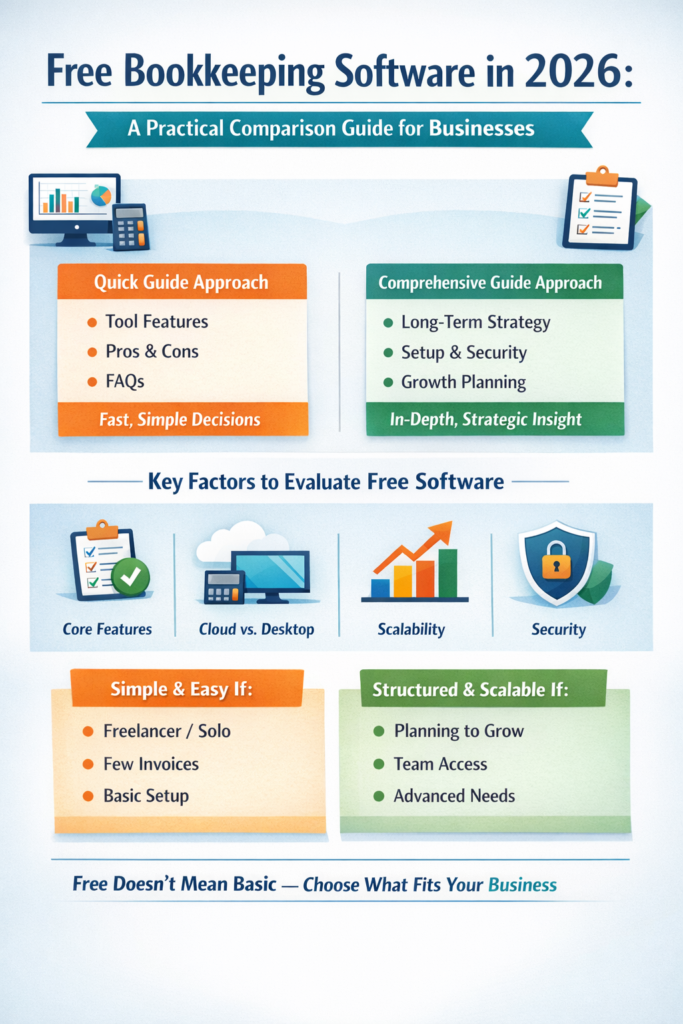
Blog Approach 1: Tool-Focused and Feature-Driven
- Shorter format
- Straightforward tool descriptions
- Basic pros and cons
- Simple comparison table
- Direct answers to FAQs
This style is useful for:
- Quick readers
- Beginners
- Users looking for a fast decision
However, it lacks deeper insights into implementation, security, long-term planning, and operational impact.
Blog Approach 2: Strategic and Decision-Oriented
- Long-form educational guide
- Explains why bookkeeping matters
- Discusses migration and workflow setup
- Covers security, scalability, and adoption
- Includes future-proofing advice
This style benefits:
- Growing businesses
- Founders thinking long-term
- Decision-makers evaluating risk
However, it may feel overwhelming for users who simply want a quick comparison.
What Actually Matters When Choosing Free Bookkeeping Software
Instead of focusing on brand names, focus on these five evaluation categories:
1. Core Accounting Capabilities
Every free bookkeeping tool should provide:
- Income and expense tracking
- Invoice creation
- Basic financial reports
- Bank reconciliation
- Multi-device access (if cloud-based)
If any of these are missing, the tool may create more work than it saves.
2. Cloud vs. Desktop Models
Free bookkeeping tools typically fall into two categories:
Cloud-Based Software
- Accessible from anywhere
- Automatic backups
- Real-time synchronization
- Easier collaboration
Desktop Software
- Full offline access
- Greater data control
- No reliance on internet
- Manual backups required
The right choice depends on your business structure and comfort with cloud security.
3. Scalability and Growth
One major gap between the two blog styles was long-term thinking.
Before selecting free software, ask:
- Is there a user limit?
- Is there an invoice cap?
- Does it support multiple currencies?
- Can it handle inventory if needed?
- Is there an upgrade path available?
Free tools work best when they align with your projected business size for the next 12–24 months.
4. Implementation Complexity
The shorter blog briefly lists features but does not discuss setup effort. The longer guide dives into migration planning and workflow optimization.
Important setup considerations:
- Data import process
- Chart of accounts configuration
- Bank feed accuracy
- Role-based user access
- Report customization
A tool is only “easy” if your team can implement it correctly.
5. Security and Data Protection
The strategic blog includes stronger coverage of:
- Encryption
- Backup systems
- Access controls
- Compliance awareness
Free software still handles sensitive financial data. Security should never be overlooked simply because the tool is free.
Strengths and Weaknesses of Each Blog Approach
| Category | Blog Style 1 (Quick Guide) | Blog Style 2 (Comprehensive Guide) |
|---|---|---|
| Readability | Easy and fast | Detailed but longer |
| Depth | Basic feature comparison | Strategic business insight |
| SEO Structure | List-based | Educational and structured |
| Implementation Advice | Minimal | Strong guidance |
| Security Coverage | Limited | Thorough |
| Ideal Audience | Beginners | Growing businesses |
A Balanced Decision Framework
If you want a practical way to evaluate free bookkeeping tools, use this decision checklist:
Choose Simplicity If:
- You are a freelancer or solo entrepreneur
- You issue fewer than 50 invoices per month
- You don’t manage inventory
- You want minimal setup
Choose Structured, Scalable Systems If:
- You plan to hire employees
- You work with an accountant
- You manage multiple revenue streams
- You anticipate growth within 1–2 years
Common Mistakes Businesses Make
Regardless of which free tool you choose, avoid these errors:
- Mixing personal and business finances
- Skipping monthly reconciliation
- Ignoring data backups
- Using inconsistent expense categories
- Delaying software setup
Free bookkeeping tools only work well when supported by disciplined financial habits.
Final Thoughts: Free Doesn’t Mean Basic
Both blog approaches offer value:
- One simplifies the decision.
- The other strengthens strategic understanding.
The smartest approach combines both:
- Start with a clear feature comparison.
- Evaluate setup effort.
- Assess long-term scalability.
- Review security practices.
- Align the tool with your operational complexity.
Free bookkeeping software can absolutely support a growing business — but only if selected thoughtfully.
The real decision is not which tool is most popular.
It’s which structure supports your workflow, growth goals, and financial discipline.
When used properly, free bookkeeping software isn’t just a cost-saving measure — it becomes a foundation for better business decisions.